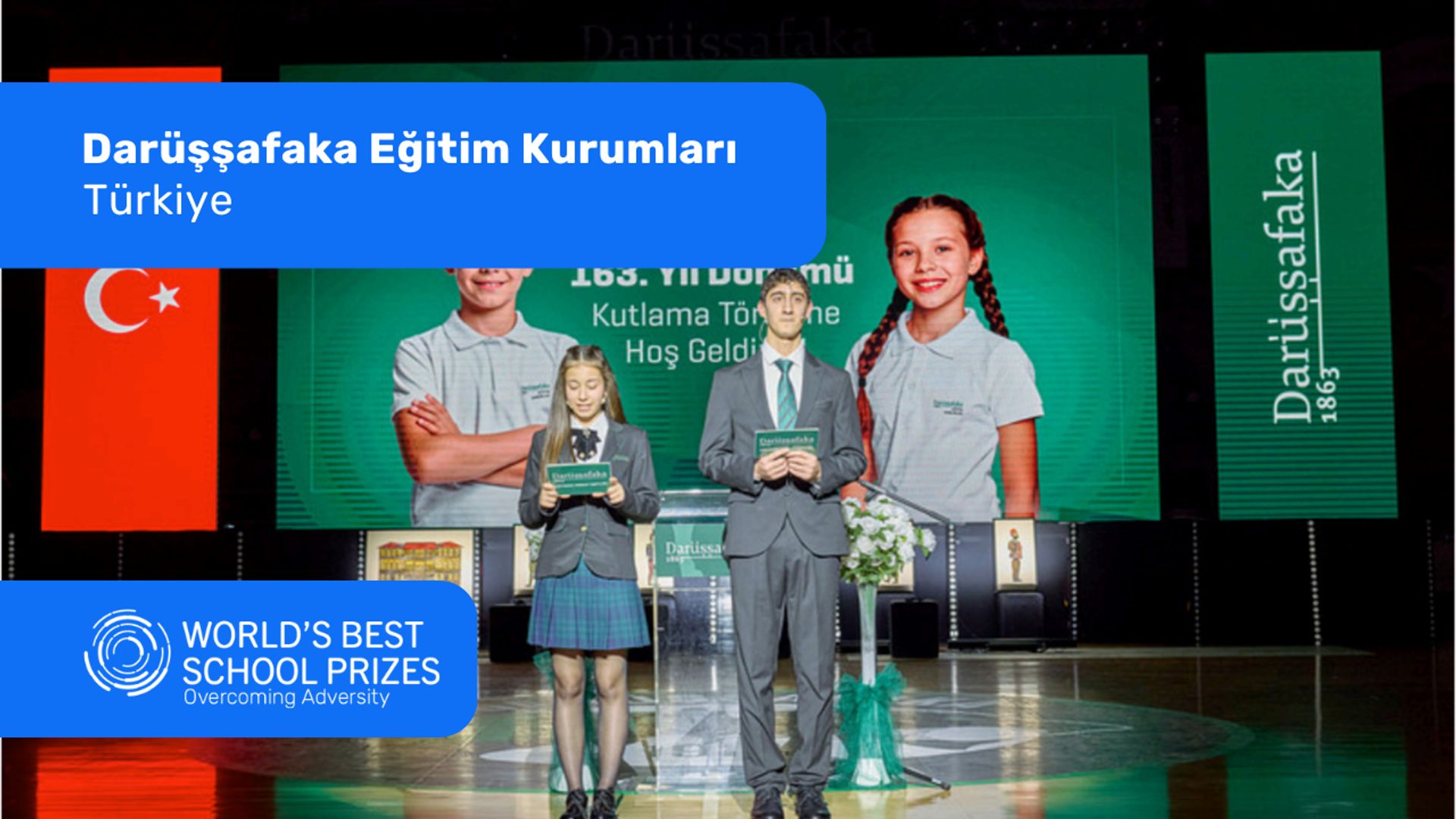
Darüşşafaka Eğitim Kurumları
- Istanbul, Türkiye
- The Turkish school that extended education beyond the campus to reach children after one of the country’s worst earthquakes
-
Darüşşafaka Eğitim Kurumları, a full-scholarship boarding school in Istanbul, Türkiye, is transforming how education systems respond to crisis by combining high-touch pastoral care with an adaptive remote learning model that helps vulnerable children remain connected to learning, stability and future opportunity even during profound disruption. Rather than allowing loss and financial hardship to define the limits of a child’s future, Darüşşafaka was created to provide high-quality education, long-term care and social protection for children facing profound adversity. Today, the institution continues this mission by supporting students across Türkiye who have lost one or both parents and whose financial circumstances would otherwise prevent access to high-quality education.
The school operates through a fully funded boarding model where students receive accommodation, meals, healthcare, counselling, educational materials, extracurricular opportunities and continuous academic support within a structured residential environment. Beyond academic support, teachers, counsellors and boarding staff also work collaboratively to help learners rebuild their confidence and emotional stability following experiences of grief, hardship or instability.
This approach became critically important following the devastating Türkiye–Syria earthquakes of February 2023, one of the deadliest disasters in the country’s modern history. Thousands of children lost parents, homes, schools and stable daily routines almost overnight. For Darüşşafaka, the disaster brought to light the even greater education challenge of how continuity, belonging and personalised support can be maintained for vulnerable children when physical relocation and traditional schooling were no longer immediately a possibility.
Rather than limiting its response to emergency relief or expanding only physical boarding capacity, the school developed an innovative two-track continuity model designed around the different lived realities students were facing. The first pathway expands the institution’s on-campus boarding intake with an additional 100 places specifically for students from earthquake-affected provinces. These students were given access to a fully supported boarding environment that combined academic transition support with psychological counselling, mentorship and a stable daily structure designed to help restore their emotional security after the trauma.
The second pathway has become one of the school’s most distinctive innovations. Recognising that many children could not immediately relocate because of family responsibilities, housing instability or emotional readiness, Darüşşafaka adapted its traditionally campus-based support model into a scholarship-supported remote learning system capable of operating across disaster-affected regions. Students receive tablets, internet connectivity and pre-installed educational applications, while dedicated teaching teams deliver live online lessons, personalised tutoring, academic mentoring and continuous progress monitoring aligned with the national curriculum.
Importantly, the remote programme was not designed simply as digital content delivery. The school intentionally recreates many of the relational and emotional support structures normally embedded within its boarding environment. Teachers have regular individual contact with students and monitor engagement closely to ensure that children experiencing grief, displacement and instability stay connected to trusted adults, daily structure and long-term learning.
The flexibility of the model allows the school to respond to highly individual student circumstances. Some learners transition into the boarding environment immediately, while others stay within their home communities while receiving remote support until relocation becomes a possibility if they require it. In both pathways, the school prioritises continuity of learning, emotional wellbeing and sustained human connection rather than just treating crisis response as a temporary intervention.
The school’s broader pedagogy is rooted in a holistic understanding of education and child development. Alongside strong academic preparation and English-intensive learning, students have the chance to get involved in arts, sports, clubs and values-based programmes specifically designed to build their resilience, leadership and capabilities. Counsellors are embedded and freely available at every stage of the learner’s journey, and teachers build long-term mentoring relationships to become trusted guides and advisors as students’ progress.
The measurable impact of the continuity model has shown great success. Following the earthquakes, Darüşşafaka increased its annual intake from approximately 120 to 220 students in 2023, admitting 100 additional students from 11 earthquake-affected provinces into the boarding programme. Across 2023 and 2024, the institution supported a total of 400 earthquake-affected children through its two-track model, with 200 students receiving full-scholarship boarding education and 200 students supported through remote learning pathways.
The school reports a university placement rate of 98%, and in a country where the high school dropout rate is estimated at around 30%, Darüşşafaka reports a dropout rate of 0%. Students also achieve strong international benchmarks, with the school maintaining an average IELTS score of 6.5 over the past five years.
The institution’s work is sustained through an extensive network of donors, partners and supporters who collectively fund every aspect of the student experience, from accommodation and meals to technology, travel and enrichment opportunities. This ecosystem of support has enabled the school not only to sustain its long-standing boarding model but also to rapidly extend that support infrastructure into remote and crisis-affected contexts when needed most.